

AI Testing & Quality Engineering Services

TEST AI. ENGINEER QUALITY. BUILD TRUST AT SCALE.

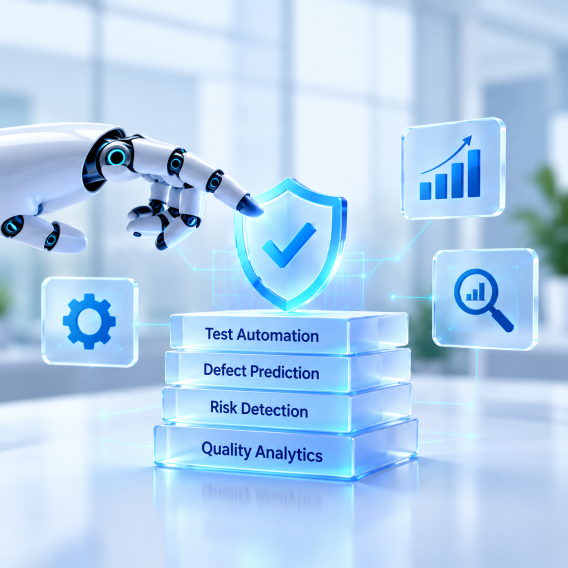
USM Business Systems helps enterprises build that confidence through AI Testing Services, AI Application Testing, AI Model Testing Services, and Quality Engineering for AI, combining test automation, model evaluation, security testing, and continuous monitoring to move AI applications from experimentation into dependable, everyday use.

15774a66 98ea 4254 873c 77081e58289a

Where AI Quality Becomes Business Risk?

An AI system can work technically and still create business problems. Incorrect responses can affect decisions. Hallucinated content can reduce customer trust. Model drift can impact prediction accuracy. Security vulnerabilities can expose sensitive information. Performance issues can prevent an AI application from scaling.

USM’s AI Testing and Quality Engineering approach helps enterprises identify these risks earlier and establish measurable quality controls before AI applications reach production. The goal is not simply to test AI. It is to build confidence in using AI at scale.

Our AI Testing Services
for Enterprise-Ready AI

A model can be accurate, and the application can still fail. USM’s six core services cover the model, the application built around it, and everything in between.

12953772 Jan Business report 1

A broken integration, a poorly tuned prompt, retrieval step pulling the wrong context, or a workflow that mishandles an edge case, none of these are model problems, but all of them break the user's experience. This validates the layer surrounding the model. USM's AI Application Testing validates the layer surrounding the model:

  • Functional and workflow testing for AI features
  • Prompt and response validation
  • Retrieval-augmented generation (RAG) testing
  • API and integration testing
  • End-to-end and cross-platform testing
  • Regression testing after model or prompt changes
  • User journey and experience validation
One AI Quality Strategy.
Multiple Testing Dimensions.

AI Testing Area What We Validate Enterprise Value
AI Application Testing Workflows, features, integrations, prompts, and user journeys Reliable AI applications
AI Model Testing Services Accuracy, consistency, robustness, and model behavior Greater model confidence
Generative AI Testing Responses, hallucinations, relevance, grounding, and safety More dependable GenAI
Machine Learning & Model Testing Predictions, accuracy, robustness, drift, and model performance Reliable ML systems

1.

Functional Testing

Validate application features, workflows, integrations, and end-to-end user journeys with Functional Testing Services. Our Software Functional Testing, Application Functional Testing, and End-to-End Functional Testing ensure AI applications work as intended across critical business processes

2.

Test Automation

Accelerate quality with Test Automation Services covering functional, regression, API, integration, and AI testing. Our Enterprise Test Automation, Test Automation Framework, QA Test Automation Services, and Automated Testing Solutions enable continuous, repeatable validation.

3.

Security Testing

Protect applications, APIs, data, and AI components with Security Testing Services. Our Application Security Testing, Web Application Security Testing, Software Security Testing, Enterprise Security Testing, and Cybersecurity Testing Services help identify vulnerabilities across the application landscape.

4.

Performance Testing

Ensure applications remain reliable at scale with Performance Testing Services. Our Application Performance Testing, Software Performance Testing, Load Testing Services, Stress Testing Services, and Performance Engineering Services help validate speed, stability, scalability, and capacity.

Quality Engineering for AI

Quality Engineering (QE) for AI moves testing beyond a final release checkpoint and integrates quality throughout development, deployment, and production. USM’s AI-powered QE approach combines risk-based testing, continuous evaluation, intelligent test automation, model-aware quality engineering, and production quality monitoring.

Group 425

Risk-based testing

Prioritize scenarios where a wrong output causes the most business damage.

Group 423

Continuous evaluation

Re-test as models, prompts, and data change, not just at release.

Group 426

Intelligent test automation

Automate the repeatable evaluations and regression scenarios.

Group 430

Model-aware quality engineering

Assess application and model behavior together, never in isolation.

Group 432

Production quality monitoring

Identify changes in live AI behavior that controlled testing environments may not reveal.

FROM ASSESSMENT TO CONTINUOUS AI QUALITY

USM’s AI Testing Framework
Across the AI Application Lifecycle

AI quality cannot be treated as a final testing phase. USM integrates testing and quality engineering throughout the AI lifecycle, from data and model development to application deployment and continuous monitoring.

01

Discover

Understand the AI application’s purpose, users, workflows, model architecture, data dependencies, risks, and expected outcomes.

02

Define

Establish quality criteria, evaluation metrics, test scenarios, risk thresholds, and acceptance criteria.

03

Test

Validate AI functionality, model behavior, responses, integrations, security, performance, and user experience.

04

Evaluate

Measure accuracy, relevance, consistency, robustness, safety, and other AI-specific quality indicators.

05

Automate

Build repeatable automated evaluation and testing into development and deployment workflows.

06

Monitor

Continuously evaluate AI behavior as models, prompts, data, integrations, and application environments change.

3265112g

From AI Experiment to
Enterprise-Ready Application

AI Use Case

Define the business objective, users, expected behavior and risk.

Automated Evaluation

Build repeatable scenarios for model and application behavior.

Data & Model

Validate data quality, model behavior, and evaluation criteria.

Security & Performance

Stress-test resilience, response time, and scale.

AI Application

Test prompts, workflows, integrations, retrieval, and real interactions.

Regression & Monitoring

Track quality changes, detect regressions, and monitor model performance.

AI Testing for Business-Critical Applications

AI quality requirements depend on how the technology is being used. USM aligns testing with the risk, accuracy, security, performance, and reliability requirements of each business application.

1.

AI Assistants & Copilots

Validate responses, grounding, safety, prompts, integrations, and user workflows.

2.

Predictive & Machine Learning Applications

Evaluate accuracy, robustness, model drift, predictions, and production behavior.

3.

Intelligent Automation

Test workflows, integrations, APIs, business rules, and AI-driven decisions.

4.

AI-Powered Enterprise Applications

Combine functional, model, security, performance, and end-to-end testing across the complete application.

Why Enterprises Choose USM for AI Testing

AI Testing Beyond Traditional QA

AI systems require testing approaches that account for probabilistic outputs, model behavior, data dependencies, and evolving AI components.

Application and Model Testing Together

We evaluate both the AI model and the application surrounding it so quality issues are not hidden between technology layers.

Automation Where It Creates Value

Automated evaluation can help teams repeatedly test high-volume scenarios, regression cases, prompts, and AI outputs.

Quality Engineering Throughout the Lifecycle

Testing is integrated across development, deployment, and production rather than treated as a final checkpoint.

Enterprise-Focused Approach

Testing priorities are aligned with business processes, application architecture, AI use cases, risk, and operational requirements.

Built for Evolving AI Systems

AI applications continuously change as models, prompts, data, retrieval sources, and application components evolve. Quality practices need to evolve with them.

What Enterprises Gain

A mature AI testing strategy can help organizations build greater confidence in AI adoption.

3265112
3265112g

1.

Greater AI Reliability

Improve confidence in application andmodel behavior.

2.

Earlier Defect Detection

Identify functional, AI-quality, security,and performance issues earlier.

3.

Faster AI Validation

Power BI, Tableau, and Qlik dashboards are designed for the people who’ll actually open them at 8am on a Monday.

4.

Better Model Quality

Measure model behavior against defined technical and business criteria.

5.

Reduced AI Risk

Identify reliability, security, safety, and quality issues before they become larger problems.

6.

More Confident AI Releases

Create repeatable quality gates for AI applications and models.

Build Trust into Every AI Release

USM Business Systems helps enterprises move beyond AI experimentation by building structured testing and quality engineering practices around AI-powered applications and models. From AI Application Testing and AI Model Testing Services to Generative AI Testing, Machine Learning Model Testing, and Quality Engineering for AI, we help organizations build AI systems that are more reliable, secure, scalable, and ready for real-world use.

Frequently Asked Questions

AI Testing Services evaluate AI-powered applications and models to determine whether they produce reliable, accurate, secure, consistent, and business-appropriate results. They can include AI application testing, model testing, generative AI testing, machine learning model testing, security testing, performance testing, and automated evaluation.
AI consulting services can include strategy, use-case identification, readiness assessment, implementation planning, governance, and transformation.
AI strategy consulting helps enterprises identify valuable AI opportunities and create a practical roadmap for implementation.
AI strategy focuses on identifying opportunities and defining the roadmap, while implementation focuses on putting those solutions into operation.
Companies evaluate business objectives, available data, technical readiness, expected value, and implementation requirements.
Enterprises can measure AI ROI through improvements in productivity, efficiency, revenue, cost reduction, customer experience, and other measurable business outcomes.
Cart (0 items)

Create your account