


How a Supply Chain Analyst Agent Works?
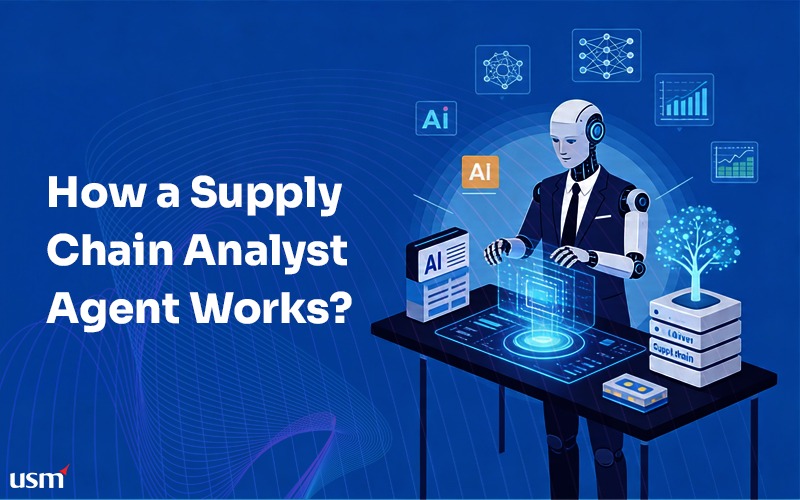
How a Supply Chain Analyst Agent Works?
The 5 Things It Does That Your Team Doesn’t Have Time For
The question we get most often in the first conversation with a supply chain leader is not ‘can AI do this?’ It is ‘what exactly does it do, and what does it replace?’
That is the right question. And the answer is specific.
A supply chain analyst agent does not replace supply chain judgment. It replaces the manual work that happens before the judgment. The reconciling, the assembling, the waiting-for-the-report work that consumes hours every week and still produces outputs that are already stale by the time anyone reads them.
USM Business Systems builds supply chain analyst agents for mid-market manufacturing, distribution, and logistics companies. Here is what those agents actually do.
1. Continuous Data Reconciliation
Most supply chain teams reconcile data manually. Lead times from supplier confirmations. Inventory positions from the WMS. Demand signals from the order management system. Purchase order status from the ERP. All of it coming in at different cadences, in different formats, from different systems.
The agent handles all of that continuously. Lead times update when supplier confirmations come in. Inventory positions update as transactions process. Demand signals update as orders come through. The team opens the dashboard and the picture is current.
- Time recovered: 4-10 hours per analyst per week
- Decision quality improvement: leadership briefs off data that is hours old, not days old
2. Automated Exception Surfacing
The most expensive supply chain problems are the ones nobody noticed until they became commitments. A supplier whose lead times have been drifting for three weeks. Inventory coverage that is thinning on a high-velocity SKU. A demand pattern that has shifted since the last forecast cycle.
The agent monitors the operation continuously and surfaces exceptions automatically. It does not wait for the weekly review. It flags the situation when the threshold is crossed.
- Near-miss visibility window extends from hours before a problem to days before
- The team shifts from reactive response to proactive resolution
3. Root Cause Analysis on Demand
When a supply chain problem does occur, the investigation typically takes longer than the resolution. Where did the breakdown start? Which supplier? Which lane? Which upstream signal was the leading indicator?
The agent traces disruptions backward through the data and presents the cause with supporting evidence. The supply chain leader does not spend Monday morning running the investigation. They receive the analysis and move to the response.
- Mean time to root cause: reduced from days to hours
- For manufacturers where downtime runs $10K-$50K per hour, this is direct margin protection
4. Plain-Language Scenario Modeling
Supply chain decisions under uncertainty require modeling. What happens to coverage if Supplier A delays by three weeks? What does re-sourcing to Supplier B do to landed cost and lead time? What is the inventory exposure if demand holds at the current pace through Q3?
Historically, running those scenarios required an analyst, a spreadsheet, and time that is usually not available before the decision needs to be made.
The agent accepts plain-language questions and returns modeled answers. The procurement leader or ops director asks the question and gets the output in minutes. The decision is made with the modeling, not in spite of the absence of it.
5. Automated Reporting and Narrative Generation
Weekly ops reviews, supplier scorecards, and executive summaries do not disappear when a supply chain agent is deployed. What changes is who builds them.
The agent generates those reports automatically, from the live data it is already reconciling. The narrative is written. The tables are populated. The anomalies are flagged.
The supply chain team does not spend Thursday building Friday’s report. Reporting becomes a byproduct of operations, not a project with a deadline.
- 4-8 senior team hours recovered per week on report assembly
- Version control and manual error risk eliminated
The teams that get the most out of supply chain AI are not the ones with the biggest budgets. They are the ones who identified one specific problem and ran a contained build on it first.
What the First Deployment Looks Like?
USM scopes every supply chain agent engagement in two weeks. We identify the one or two problems with the clearest ROI and the fastest measurement cycle. We build to that scope. We measure from week one.
Most first deployments are live within 8-12 weeks. The team starts using the output before the quarter is out.
Request a 30-minute Supply Chain Agent walkthrough at usmsystems.com. See the live system, not the slide deck.