
Why Your Clinical Operations Teams Are Always Behind (And What AI Does About It)?
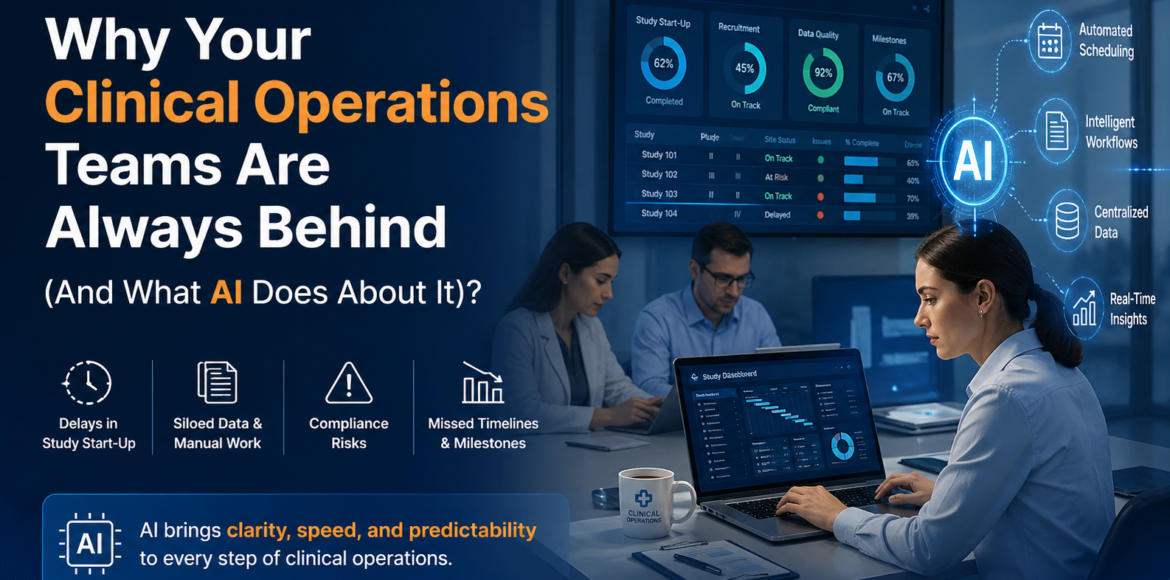
Why Your Clinical Operations Teams Are Always Behind (And What AI Does About It)?
It is Thursday afternoon. Your clinical operations coordinator has been in the data since 9 AM. A prior authorization status changed Tuesday. Patient volume shifted Wednesday. The throughput report you need for the Friday leadership review is not going to reflect either of those things.
This is a data latency problem. And it is happening in clinical operations teams everywhere.
USM Business Systems works with mid-market health systems, specialty pharmacy operators, and pharma/CRO organizations to build AI-powered clinical operations visibility systems. What we see consistently: the gap is not how skilled the team is. The gap is how fast the data gets to them.
Why Clinical Operations Teams Are Always One Step Behind?
Most clinical operations teams work from snapshots. They pull from the EHR. They check the prior auth queue. They reconcile payer status updates from fax confirmations and portal logins. They build the picture manually, then brief leadership off that picture.
By the time the picture is complete, it reflects what happened three days ago.
When a payer changes authorization criteria, patient census spikes, or a specialty drug hits a procurement delay, the first signal is often a missed commitment or a denied claim, not a dashboard alert.
The teams with the best clinical outcomes and the strongest revenue cycle performance are the ones with the fastest signal-to-decision cycle.
The organizations closing that gap are building continuous signal coverage into the operation itself.
What AI Actually Changes in Clinical Operations?
AI does not replace clinical judgment. What it eliminates is the manual work that sits between the data and the judgment.
Here is what that looks like in practice:
- Prior authorization statuses update automatically when payer portals or EDI transactions confirm decisions, without a coordinator manually checking five payer portals each morning
- Pharmacy intake processing runs on live prescription data and formulary signals, not the last batch pull from overnight
- Denial risk flags surface in the morning standup, before the claim goes out and generates a write-off
- Scenario modeling on patient volume changes or formulary shifts takes minutes, not the next planning cycle
The operations leader does not spend Wednesday building the Thursday report. The report is already built. They spend Wednesday making decisions.
The Build vs. Buy Question
Off-the-shelf healthcare operations platforms make assumptions about your EHR configuration, your payer mix, and your workflow architecture that often do not match reality. A mid-market health system running two EHRs from a merger and a prior auth workflow that still routes through fax is not going to get clean output from a platform built for median-case infrastructure.
A custom-built clinical operations AI agent is trained on your actual data schema, your payer relationships, your authorization criteria and denial patterns. It knows what your operation looks like, not what the average operation looks like.
The build timeline is typically 8–12 weeks for an initial deployment. The ROI window, based on the engagements USM has completed, is 6–12 months, after which the system operates at a fraction of the cost of the coordinator hours it replaces or augments.
What the Transition Looks Like?
For most clinical operations teams, the starting point is one problem they already know they have.
Prior auth backlogs that do not reflect actual payer decisions. Pharmacy intake processing that is always 24 hours behind the prescription. Denial trends that surface after the write-off instead of before the claim.
Pick one of those. Build the agent around it. Measure the time and decision quality improvement. Then expand.
That is the architecture USM – AI app development company, uses with every healthcare operations engagement. Scoped in two weeks. Built in 8–12. Measured from day one.
See how USM’s Clinical Operations AI works in a 30-minute live walkthrough. Request a demo at usmsystems.com.